Sliding door rollers fail early here because salt attacks the bearing races inside the wheel and sand grinds the wheel surface from outside.
Stainless steel ball-bearing rollers are the practical answer, and an annual track clean does more for roller life than any other single thing.
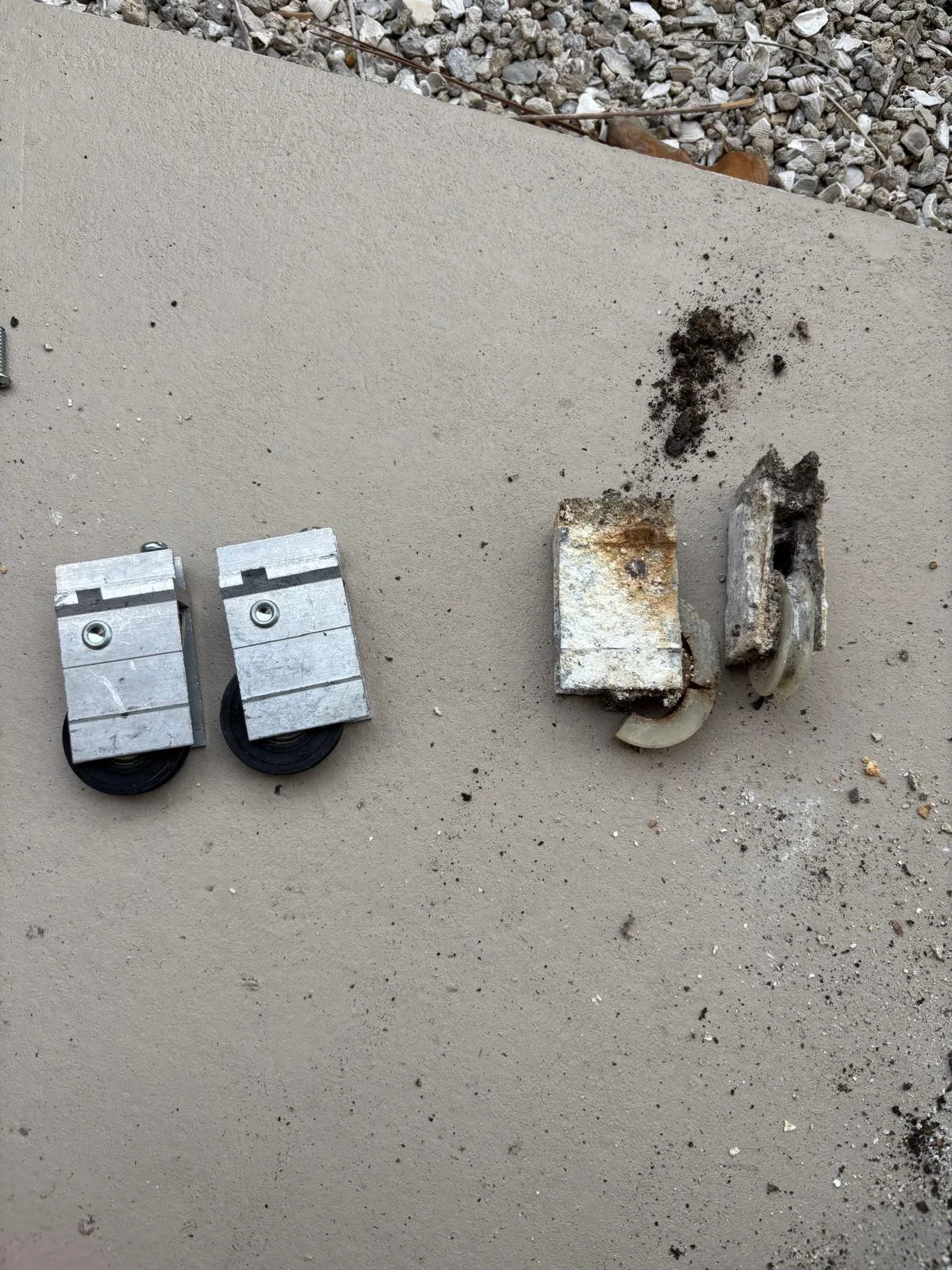
The Part That Actually Fails
A sliding door roller is not really a wheel. It is a small steel carriage holding two wheels, and each wheel turns on a bearing. The bearing is the part that fails, and it fails out of sight.
Salt-laden air reaches the bearing race through the same gap the wheel turns in. Once corrosion starts in there, the race roughens, the rolling resistance climbs, and eventually the wheel stops turning altogether.
By the time you feel it at the handle, the wheel has usually been skidding rather than rolling for a while. That skidding is what starts cutting the sill.
Sand Does the Second Half of the Damage
Every sliding door sill collects grit. In Martin County that grit is fine, abrasive sand, and it sits exactly where the wheel meets the track.
The result is a grinding paste between two surfaces under the full weight of a glass panel. Nylon wheels flat-spot against it, which is the thump you feel every few inches, and steel wheels transfer the wear into the aluminium sill instead.
This is why keeping the track clean is not cosmetic maintenance. It removes the abrasive from the equation entirely.
Why Nylon Rollers Are Fitted Anyway
Nylon and plastic wheels are cheap, quiet and perfectly adequate in a dry inland climate. Volume builders fit them because they work well enough for the warranty period.
They are a poor match for a coastal Florida sill. Nylon does not corrode, but it deforms, and a deformed wheel drags rather than rolls, which produces the same downstream damage as a seized bearing.
Steel ball-bearing rollers roll far better under load. Plain steel still corrodes here, though, which is why we fit stainless as standard rather than as an upgrade.
How to Tell Yours Are Going
- The door needs two hands where it used to need one finger.
- You can hear a low rumble or grinding as the panel moves.
- The gap along the top of the panel is wider at one end than the other.
- The door has started catching at a specific point in its travel.
- Turning the adjustment screws no longer makes any difference.
Any of those is worth acting on early. A stiff door is a cheap roller replacement; a door that has been dragged for a year is a roller replacement plus track work.
What Actually Extends Roller Life
Clean the track. A crevice tool along both channels once a month removes the abrasive before it does anything, and it is the highest-value minute you can spend on the door.
Use a dry PTFE or silicone lubricant, never oil or grease. Tacky lubricants hold sand against the wheel, which is worse than no lubricant at all.
Rinse the exterior frame with fresh water after storms. Salt deposited by driven spray keeps working on metal long after the weather has passed.
More From the Blog
Need a Sliding Door Looked At in Stuart?
Tell us what it is doing and we will tell you what it needs, with a price range before anyone comes out.
Call (772) 279-9387 Request a Quote